

Beyond False Fronts
Culture Work in a World that Rewards Pretending

Welcome (back) to Culture Work!
It’s hard to believe we’re nearing the end of the year, but here we are. A series of recent events got me thinking about the pressures many face to appear invulnerable, how organizations can face similar pressures, and how this acts as a barrier to culture work. I hope you enjoy this one and welcome your thoughts in the comments.
Earlier this month, I attended a webinar for entrepreneurs. The session wasn’t well-attended and as a trainer myself, I make a point in such cases to show up ready to participate. I know how it feels to expect engagement with participants and instead get crickets.
The topic of the webinar turned to the roller coaster nature of self-employment—sometimes you’re up and sometimes you’re down.
When asked, I shared about challenges navigating this year’s economic downturn as a consultant and the difficulty of distinguishing between what I could be doing differently and what’s out of my control. I’d been talking to other consultants, including some more well-established than I am, and knew that others were struggling with similar things. It wasn’t hard for me to be open about it.
In the moment, the presenter thanked me for my openness and we got to have a meaningful conversation about navigating such challenges. Afterward, I stayed on to chat with the webinar’s host and joked about my propensity toward openness on recorded webinars.
She responded that she knows a lot of people are going through the same thing but not talking about it, and noted the pressure to present yourself as “successful” because clients want to work with successful people.
It got me thinking.
In many ways, our culture rewards fakeness and pressures us to appear flawless.

The consultant who’s projecting confidence and success while struggling behind the scenes…
the leader who’s projecting a pretty picture to their board while deep in burnout and operational challenges…
the employee who’s telling their manager that everything’s fine when they feel completely lost…
I object to all of it—not to the individuals feeling the pressure to keep up a front, but to cultures that demand it.
One of the challenges with culture work is that it is vulnerable work.
It asks us to face problems instead of ignoring them.
It asks us to value progress, learning, and growth over perfection.
It requires emotional maturity, vulnerability and the building psychological safety, and the willingness to have hard conversations.
And most of all, it asks leaders to model these things to make it safe for others to do the same.
This goes against some deep-rooted cultural norms—and that’s the work.
In a sense, it’s hard work. But I also see routinely how keeping up the front is hard work, too.

Dealing with repetitive, unresolved conflicts is hard.
Trying to collaborate amidst unspoken disagreements is hard.
Working in isolation and disconnection is hard.
Constantly overextending is hard.
My job is to support clients in facing challenges to get to the good stuff: breaking out of unhelpful patterns, strengthening workplace communication and relationships, and reducing risk by fostering greater reflection and accountability in organizations.
This is sensitive work, and it is made more sensitive and vulnerable by a culture that too often rewards the maintenance of unaddressed dysfunction behind a picture-perfect facade. It’s made more difficult by a society that, in many ways, doesn’t value culture work.
We shouldn’t be made to feel ashamed for imperfection when that’s a part of being human, or for struggling when powerful forces are manufacturing conditions of struggle.
Workplace conflict, growing pains, and communication breakdowns are all normal—not something to be ashamed of.
A culture that rewards pretending, avoidance and superficiality is the real shame—and the bigger risk.
It is my hope that we can do better as a culture to celebrate leaders and organizations for facing what’s not working or what’s causing harm, and working to address issues—rather than rewarding a false image of flawlessness.
Just as employees need psychologically safe environments in which to speak up and acknowledge mistakes, so too do leaders and organizations.
How are boards making space for real conversations about internal culture and operations in strategic planning processes? How are funders valuing and advancing culture work?
And how are we as a culture rewarding organizations for reflection and development? How are we shifting our expectations from perfection and purity toward learning and growth?
Culture work is not about purity, perfection, or superficiality. It’s also not about solving every problem immediately. It’s about a willingness to get real: to go deeper, reflect, learn, and grow in how we embody our values as leaders, professionals, and organizations.

I am honored to work with organizations that value culture work and am proud to reflect on the courageous, collaborative work this year held, including:
a webinar series for a state library client that promoted mental health, open communication, and productive conflict at work;
an in-depth culture assessment with a governmental client that is now driving developments to policy, practice, and internal communications; and
consulting and facilitation with a nonprofit client to surface key issues, get real about resources, and bridge communication gaps.
As we enter 2026, how will we continue the work to build cultures that support physical and psychological safety, genuine connection and strong collaboration?
To boards and funders: how will you support and celebrate organizations in their culture work?
As for me, I look forward to more collaborations in the new year that reject the false front in favor of real reflection and growth.
Hi, I’m Rebecca, a workplace culture consultant who collaborates with leaders and teams so that they and their organizations can thrive, not just survive.
Whether you’re dealing with culture issues, experiencing growing pains, or looking to enhance ongoing efforts to support workplace and staff well-being, you’re in the right place. Learn more about me and Culture Work here.
Next month marks two years of this publication’s existence. I hope you’ve gotten something out of this year’s essays—whether tips and tools, food for thought, or encouragement in your work.
Looking back, the Top 3 Posts of 2025 were:
#1

#2

#3

And if you’re into what not everyone else is into? My just-established award for most overlooked essay goes to:

(IMO, this was a good one that deserved more attention than it received.)
In a world of endless content and worthy causes, I’m so grateful you choose to be here. Thank you for your attention, sharing, and financial support of Culture Work!
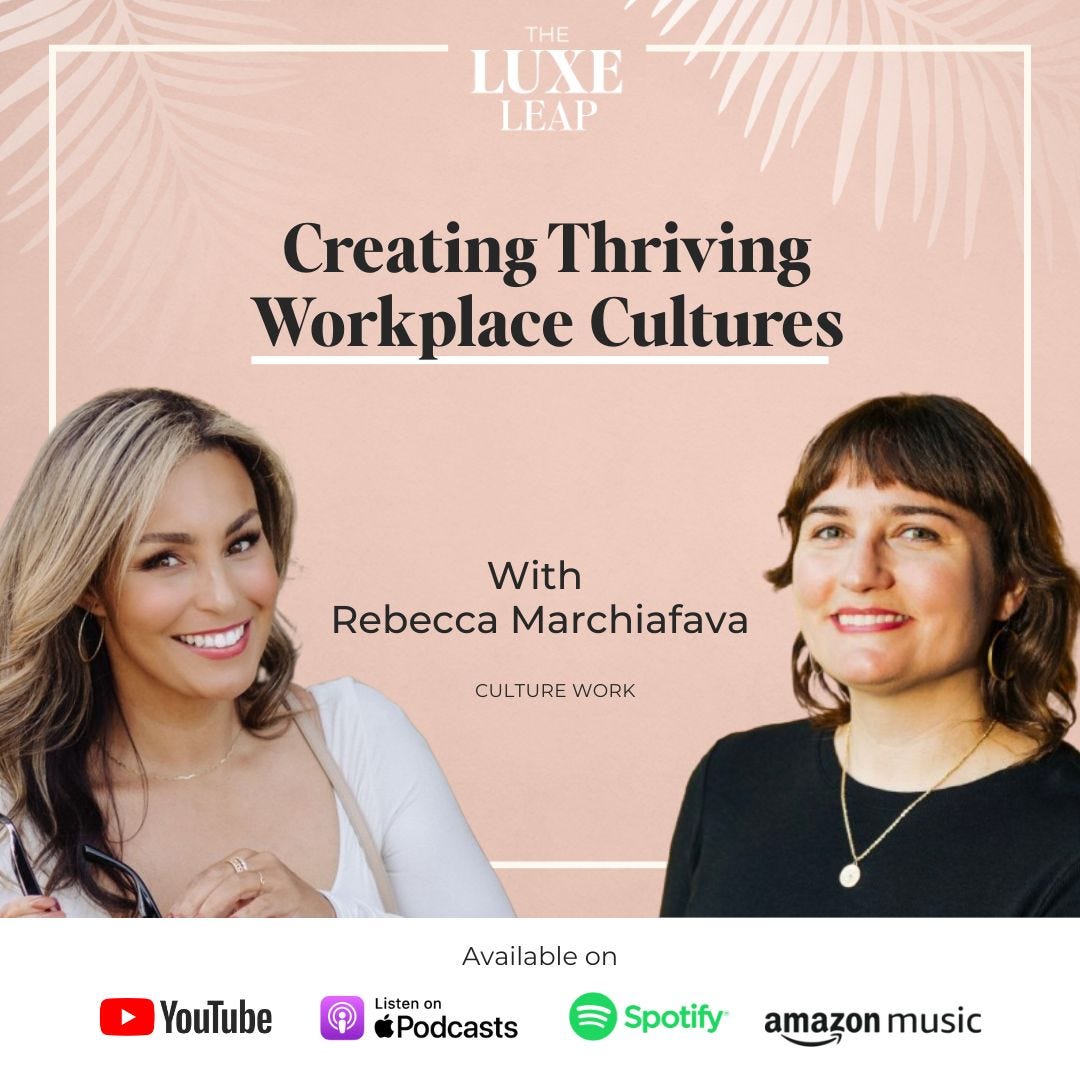
In other news, Réland Logan invited me on her podcast The Luxe Leap a while back to chat about entrepreneurship and—what else?—workplace culture. You can listen here or on the platforms listed below. Many thanks to Réland for having me!
I wish you a safe and happy holiday season, whatever that looks like for you—and I’ll see you in the new year.